


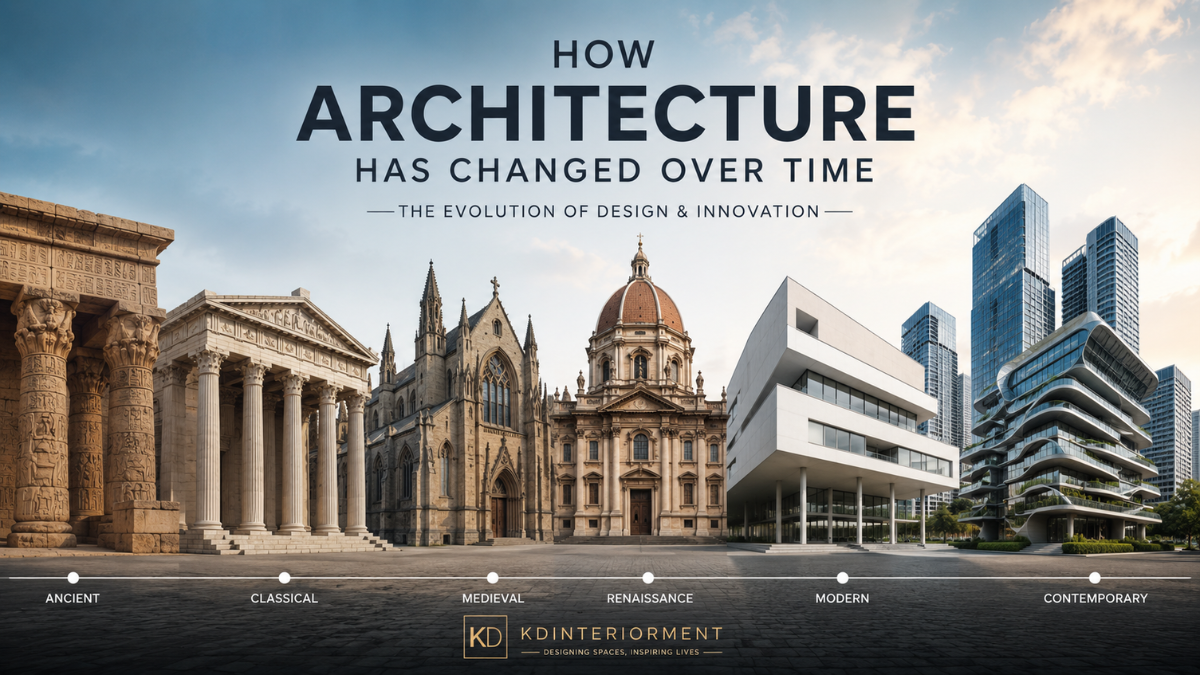
Discover how architecture has changed over time kdainteriorment, from ancient structures to modern smart, sustainable, and innovative design trends.
Architecture has always been a reflection of human civilization, culture, and technological progress. When we study how architecture has changed over time kdainteriorment, we begin to understand not just buildings, but the story of human innovation across centuries. From ancient stone structures to futuristic smart cities, architectural transformation reveals how societies adapt to needs, climate, materials, and lifestyle changes.
Understanding how architecture has changed over time kdainteriorment also helps us appreciate modern design choices in homes, offices, and public spaces. Today’s architecture is not only about beauty but also about sustainability, functionality, and emotional well-being. This long-form guide explores the complete journey of architecture, highlighting key transitions, design philosophies, and future trends.
Ancient Beginnings of Architecture and Early Human Shelter
The earliest phase of how architecture has changed over time kdainteriorment begins with simple shelters made from natural materials like mud, wood, and stone. Early humans focused on survival, so structures were built to protect against weather, wild animals, and environmental challenges.
These primitive designs slowly evolved into more organized settlements as communities formed. The use of stone in civilizations like Mesopotamia and Egypt marked the beginning of durable architectural identity. Temples, pyramids, and early urban layouts demonstrate how even ancient societies valued structure and design.
As societies grew, architecture became a symbol of power and belief systems. Massive stone constructions were not only functional but also spiritual expressions of culture and authority.
Classical Architecture and the Rise of Structured Design
The classical era played a major role in how architecture has changed over time kdainteriorment, especially with Greek and Roman contributions. This period introduced symmetry, proportion, and mathematical precision in construction.
Greek architecture focused heavily on columns, temples, and harmony in design. Roman architecture expanded these ideas by introducing arches, domes, and large-scale public buildings like amphitheaters and aqueducts.
This era marked a shift from basic construction to artistic engineering. Buildings were no longer just shelters—they became representations of intelligence, culture, and power.
Medieval Architecture and Defensive Structures
During the medieval period, how architecture has changed over time kdainteriorment reflects a strong focus on protection and religious influence. Castles, fortresses, and churches dominated architectural landscapes.
Thick stone walls, narrow windows, and defensive towers were common features designed for safety during wars and invasions. Religious architecture also flourished, with cathedrals featuring intricate designs and stained glass.
This period highlights how architecture adapts to social instability and religious dominance, creating structures that balance function and symbolism.
Renaissance Revolution in Architectural Design
The Renaissance era completely reshaped how architecture has changed over time kdainteriorment by reintroducing classical principles with enhanced creativity and human-centered design.
Architects began focusing on proportion, balance, and beauty inspired by ancient Greek and Roman styles. Buildings became more refined, with detailed facades, domes, and decorative elements.
This period also introduced architectural theory as a formal discipline. Design was no longer only practical—it became intellectual and artistic expression combined.
Industrial Revolution and the Rise of Modern Materials
A major turning point in how architecture has changed over time kdainteriorment came during the Industrial Revolution. New materials like steel, iron, and glass transformed construction methods completely.
Skyscrapers began to emerge, especially in rapidly growing cities. Functional design became more important than decorative aesthetics as urban populations increased.
This era also introduced mass production techniques, allowing buildings to be constructed faster and more efficiently. Architecture shifted toward practicality and urban development.
Modern Architecture and Minimalist Design Philosophy
Modern architecture significantly reshaped how architecture has changed over time kdainteriorment by introducing minimalism, simplicity, and functionality as core principles.
Designers started rejecting excessive decoration and focused on clean lines, open spaces, and natural light. Materials like concrete and glass became dominant in residential and commercial buildings.
This era also emphasized the relationship between humans and space. Interiors became more comfortable, functional, and aligned with daily lifestyle needs.
Contemporary Architecture and Smart Innovation
In the current era, how architecture has changed over time kdainteriorment is deeply influenced by technology, sustainability, and smart design systems.
Buildings now integrate smart systems such as automated lighting, climate control, and energy-efficient solutions. Architects also focus on eco-friendly materials and green building certifications.
Digital design tools like 3D modeling and AI-assisted planning have revolutionized how structures are conceptualized and executed.
Interior Design Influence on Architectural Evolution kdainteriorment
Interior design plays a crucial role in how architecture has changed over time kdainteriorment, especially in modern residential and commercial spaces.
Interior planning now emphasizes comfort, usability, and emotional impact. Open floor plans, natural lighting, and ergonomic furniture are key components of modern interiors.
The collaboration between architecture and interior design ensures that spaces are not only visually appealing but also highly functional for everyday living.
Comparison of Architectural Eras
| Era | Key Features | Materials Used | Purpose |
| Ancient | Basic shelters, pyramids | Stone, mud, wood | Survival & rituals |
| Classical | Symmetry, columns | Marble, stone | Culture & governance |
| Medieval | Castles, cathedrals | Heavy stone | Defense & religion |
| Renaissance | Artistic balance | Stone, early glass | Beauty & intellect |
| Industrial | Skyscrapers, factories | Steel, iron, glass | Urban expansion |
| Modern | Minimalism, open spaces | Concrete, glass | Functionality |
| Contemporary | Smart buildings | Eco-materials, tech systems | Sustainability |
This table helps explain how architecture has changed over time kdainteriorment by summarizing key transitions across different eras.
Sustainability and Green Architecture Movement
A major shift in how architecture has changed over time kdainteriorment is the rise of sustainable and eco-friendly building practices.
Modern architects now prioritize energy efficiency, natural ventilation, and renewable materials. Green rooftops, solar panels, and recycled construction materials are becoming standard features.
Sustainability is no longer optional—it is a necessity in modern architectural planning to reduce environmental impact.
Technology and Digital Transformation in Architecture
Technology has completely redefined how architecture has changed over time kdainteriorment, enabling faster design, better precision, and improved visualization.
Tools like CAD software, 3D rendering, and virtual reality allow architects to simulate buildings before construction begins. This reduces errors and improves efficiency.
Artificial intelligence is also being used to optimize space planning and structural safety, making architecture more intelligent than ever before.
Future Trends in Architecture
The future of how architecture has changed over time kdainteriorment is expected to focus on smart cities, adaptive buildings, and AI-integrated environments.
Buildings may soon respond automatically to environmental changes, adjusting temperature, lighting, and energy usage in real time.
Urban planning will also shift toward compact, efficient, and highly sustainable living spaces designed for growing populations.
Table: Key Transformations in Architectural History
| Factor | Early Architecture | Modern Architecture |
| Design Approach | Survival-based | Experience-based |
| Materials | Natural elements | Smart & eco materials |
| Technology | None | Advanced digital tools |
| Functionality | Basic shelter | Multi-purpose spaces |
| Aesthetics | Symbolic | Minimal & functional |
This comparison clearly shows how architecture has changed over time kdainteriorment from primitive needs to advanced human-centered design.
Expert Insights on Architectural Evolution
“Architecture is a living record of human progress written in stone, steel, and glass.”
“Every era builds not just structures, but lifestyles that define generations.”
These insights highlight the deeper meaning behind how architecture has changed over time kdainteriorment, emphasizing its cultural and emotional importance.
Conclusion About How Architecture Has Changed Over Time Kdainteriorment
Understanding how architecture has changed over time kdainteriorment reveals a powerful story of human progress, creativity, and adaptation. From ancient shelters to intelligent smart buildings, architecture has continuously evolved to meet the needs of society.
Today’s designs are more sustainable, functional, and technologically advanced than ever before. As we move into the future, architecture will continue to merge innovation with environmental responsibility, shaping the way humans live and interact with space.
Frequently Asked Questions About How Architecture Has Changed Over Time Kdainteriorment
What is the main idea behind how architecture has changed over time kdainteriorment?
The main idea of how architecture has changed over time kdainteriorment is to show the evolution of building design from ancient shelters to modern smart structures influenced by technology and sustainability.
How has technology influenced modern architecture kdainteriorment?
Technology has transformed how architecture has changed over time kdainteriorment by introducing digital design tools, AI planning, and smart building systems that improve efficiency and accuracy.
Why is sustainability important in architecture kdainteriorment?
Sustainability plays a key role in how architecture has changed over time kdainteriorment because modern designs aim to reduce environmental impact through eco-friendly materials and energy-efficient systems.
What are the biggest changes in architectural history kdainteriorment?
The biggest changes in how architecture has changed over time kdainteriorment include the shift from natural materials to industrial steel and glass, and from decorative designs to functional minimalism.
How does interior design connect with architecture kdainteriorment?
Interior design enhances how architecture has changed over time kdainteriorment by improving usability, comfort, and aesthetics within architectural spaces, making environments more human-centered.
