


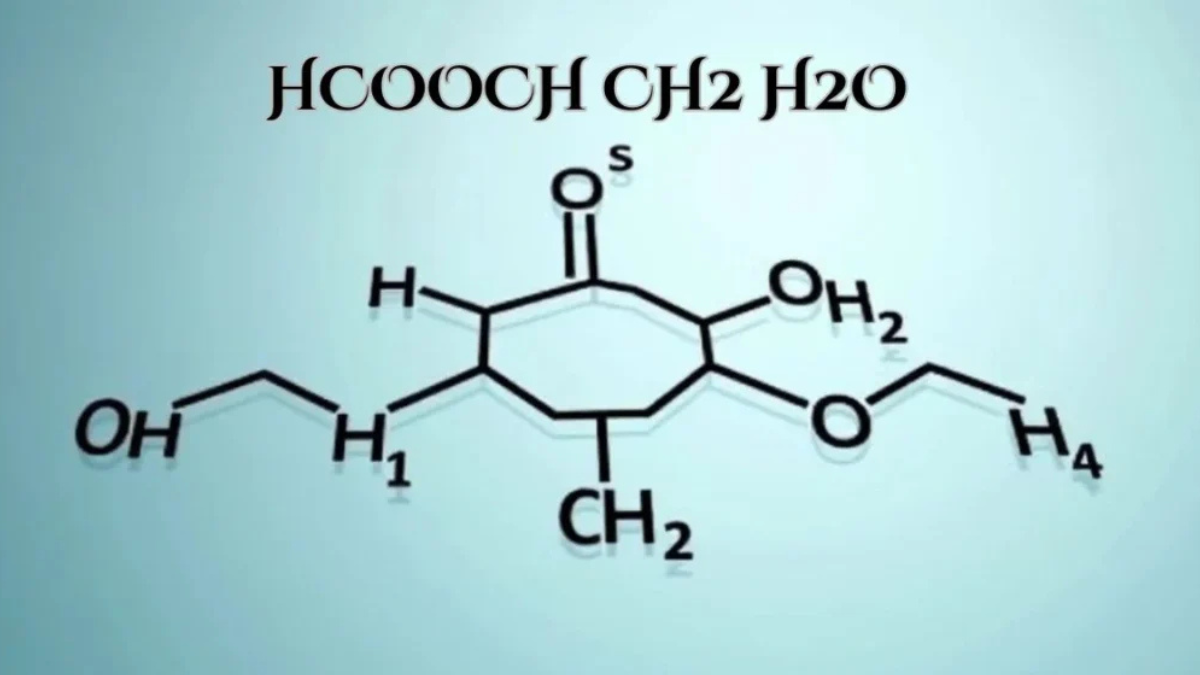
Confused about the HCOOCH CH2 H2O reaction? Get a clear breakdown of the mechanism, products, and everyday relevance in this simple guide.
If you’ve landed on this page because you searched for HCOOCH CH2 H2O, chances are you’re either a chemistry student staring at a textbook problem, a curious learner brushing up on organic reactions, or someone prepping for an exam that loves throwing ester equations at you out of nowhere. Either way, you’re in the right place. This reaction looks intimidating at first glance because of all the letters and symbols crammed together, but once you break it down piece by piece, it actually makes a lot of sense.
In plain terms, HCOOCH CH2 H2O represents the hydrolysis of vinyl formate, an ester that reacts with water to split into two smaller, more familiar compounds. We’re going to walk through what this formula actually means, how the reaction unfolds step by step, what you end up with at the end, and why chemistry teachers seem to love asking about it so much. No jargon overload, no robotic textbook tone — just a straightforward explanation that actually sticks.
What Does HCOOCH CH2 H2O Actually Mean?
Let’s start with the basics because that’s where most of the confusion happens. The notation HCOOCH CH2 H2O is a shorthand way of writing a chemical equation involving an ester called vinyl formate reacting with water. Written more precisely, it looks like HCOOCH=CH2 + H2O, where HCOOCH=CH2 is the ester and H2O is, well, ordinary water. The double bond between the carbon atoms is the part that often gets flattened out or lost when people type the formula quickly, which is exactly why so many students end up searching for HCOOCH CH2 H2O instead of the properly formatted version.
Esters like this one are formed from an acid and an alcohol, and vinyl formate specifically comes from formic acid and vinyl alcohol. Now, vinyl alcohol itself is a tricky, unstable molecule that quickly rearranges into acetaldehyde, but that’s a story for later in this article. For now, just know that when you see HCOOCH CH2 H2O written out, you’re looking at an ester hydrolysis reaction — one of the most commonly tested topics in basic organic chemistry courses around the world.
The Chemistry Behind the HCOOCH CH2 H2O Reaction
Every ester hydrolysis reaction follows a general pattern, and the HCOOCH CH2 H2O reaction is no exception. Esters react with water to produce a carboxylic acid and an alcohol (or in this case, a compound that behaves like one before rearranging). This process can happen under acidic conditions, basic conditions, or even just with plain water given enough time and the right catalyst, though it’s usually sped up with a bit of acid or base to nudge things along.
What makes this particular reaction interesting is the vinyl group attached to the ester. Instead of producing a simple stable alcohol like you’d get from a typical ester breakdown, HCOOCH CH2 H2O produces vinyl alcohol as an intermediate. Vinyl alcohol is what chemists call a tautomer, meaning it’s not stable on its own and almost instantly converts into acetaldehyde through a process called keto-enol tautomerization. This little twist is what makes the reaction a favorite among chemistry instructors who want to test whether students really understand the concept rather than just memorizing a formula.
Step-by-Step Breakdown of How HCOOCH CH2 H2O Reacts
Here’s where things get practical. When water attacks the ester bond in HCOOCH CH2 H2O, the carbon-oxygen bond breaks apart. This happens because water molecules are polar and the oxygen atom in water is drawn toward the slightly positive carbon in the carbonyl group of the ester. Once that bond breaks, the molecule splits into formic acid (HCOOH) and vinyl alcohol (CH2=CHOH).
That vinyl alcohol doesn’t stick around for long. Almost immediately, it rearranges itself into acetaldehyde (CH3CHO) through the tautomerization process mentioned earlier. So while the immediate products of HCOOCH CH2 H2O look like formic acid and vinyl alcohol, the final, stable products you’ll actually see in a lab or on paper are formic acid and acetaldehyde. This two-step nature is exactly why so many students get tripped up when writing out the full reaction — they either stop too early or forget the rearrangement step entirely.
Final Products: What You Get After the HCOOCH CH2 H2O Reaction
To keep things simple, here’s a quick table showing what goes in and what comes out when HCOOCH CH2 H2O reacts:
| Component | Chemical Formula | Role in the Reaction |
| Vinyl formate | HCOOCH=CH2 | The starting ester |
| Water | H2O | The reactant that triggers hydrolysis |
| Formic acid | HCOOH | Stable acidic product |
| Vinyl alcohol | CH2=CHOH | Unstable intermediate |
| Acetaldehyde | CH3CHO | Final stable product after rearrangement |
As you can see from the table, the HCOOCH CH2 H2O reaction isn’t a single clean step but rather a small chain of events. Formic acid stays as it is because it’s already stable, but the alcohol portion goes through one more transformation before settling into its final form. This is a great example of how organic chemistry often hides an extra twist behind what looks like a simple equation.
Why Chemistry Teachers Love Testing HCOOCH CH2 H2O
There’s a reason this specific reaction shows up so often in homework sets and entrance exams. As one chemistry professor once put it in a lecture note shared with students, “The beauty of vinyl ester hydrolysis is that it quietly tests three concepts at once — ester functional groups, hydrolysis mechanisms, and tautomerization — all in a single line of chemistry.” That’s a pretty efficient way to check whether a student actually understands organic chemistry or just memorized a handful of equations.
Beyond the academic angle, understanding HCOOCH CH2 H2O also builds a foundation for grasping more advanced topics later on, like enol-keto equilibrium, addition reactions, and even industrial processes involving acetaldehyde production. Acetaldehyde itself isn’t just a random byproduct — it’s used in manufacturing acetic acid, perfumes, and even some flavoring agents, so this “small” reaction actually connects to some pretty significant real-world chemistry.
Real-World Relevance of the HCOOCH CH2 H2O Reaction
It’s easy to assume that reactions like HCOOCH CH2 H2O only matter inside a classroom, but that’s not entirely true. Acetaldehyde, one of the final products, plays a role in several industrial processes, including the production of acetic acid, pyridine derivatives, and certain resins. Formic acid, the other product, is widely used in leather tanning, textile processing, and as a preservative in animal feed. So while the equation itself might look like something you’d only see on an exam paper, the compounds it produces show up in everyday manufacturing more than most people realize.
There’s also a bigger lesson tucked inside this reaction about how unstable intermediates behave in chemistry. Vinyl alcohol’s quick rearrangement into acetaldehyde is a textbook example of tautomerization, a concept that pops up again and again in biochemistry, pharmaceutical chemistry, and even DNA base pairing. Learning how HCOOCH CH2 H2O works isn’t just about memorizing one equation — it’s about picking up a pattern of thinking that applies to dozens of other reactions down the road.
Common Mistakes Students Make With HCOOCH CH2 H2O
One of the biggest slip-ups happens when students stop the reaction at vinyl alcohol and forget that it rearranges into acetaldehyde. It’s an easy mistake to make because vinyl alcohol looks like a perfectly reasonable final answer on paper, but in reality, it almost never exists long enough to be considered a stable product. If you’re answering an exam question about HCOOCH CH2 H2O, always remember to carry the reaction through to its true final form.
Another common error is misreading the structure entirely. Because the formula gets typed without proper subscripts, superscripts, or bond symbols in search bars and messaging apps, it’s easy to confuse HCOOCH=CH2 with something else entirely, like a branched ester or a different acid derivative. Taking a moment to draw out the structure by hand, rather than relying purely on the typed shorthand, usually clears up this confusion pretty quickly. A quick sketch of the carbonyl group, the vinyl group, and the incoming water molecule goes a long way toward avoiding silly mistakes.
Tips for Remembering the HCOOCH CH2 H2O Mechanism
A simple trick that helps a lot of students is thinking of ester hydrolysis reactions like unzipping a jacket. The ester bond is the zipper, and water is the hand pulling it apart. Once it’s unzipped, you get two separate pieces — an acid on one side and an alcohol on the other. For HCOOCH CH2 H2O specifically, just remember that the alcohol piece isn’t done changing yet; it flips into acetaldehyde right after.
Flashcards, drawing the mechanism by hand a few times, and working through a couple of practice problems usually cement this concept far better than just reading about it once. Chemistry sticks best when it’s practiced rather than passively memorized, and a reaction like HCOOCH CH2 H2O is a great one to practice on repeatedly because it’s short enough to draw out in under a minute once you know the steps.
Conclusion About HCOOCH CH2 H2O
At the end of the day, HCOOCH CH2 H2O isn’t nearly as complicated as it looks when it’s first typed out in a search bar. It’s simply the hydrolysis of vinyl formate, an ester that breaks apart when it meets water, forming formic acid and an unstable vinyl alcohol that quickly settles into acetaldehyde. Once you understand the small rearrangement step at the end, the whole reaction becomes a lot easier to picture and explain.
Whether you’re studying for an exam, helping a younger sibling with homework, or just satisfying your own curiosity, hopefully this breakdown of HCOOCH CH2 H2O gave you a clearer, more confident understanding of what’s actually going on chemically. Organic chemistry can feel overwhelming in bits and pieces, but reactions like this one are a great reminder that most of it comes down to a handful of repeating patterns once you know what to look for.
Frequently Asked Questions About HCOOCH CH2 H2O
What is HCOOCH CH2 H2O in simple terms?
It refers to the hydrolysis reaction of vinyl formate with water, producing formic acid and acetaldehyde as the final stable products.
Why does vinyl alcohol turn into acetaldehyde?
Vinyl alcohol is unstable and quickly rearranges through tautomerization into the more stable acetaldehyde molecule.
Is HCOOCH CH2 H2O an acid-catalyzed reaction?
It can occur under acidic, basic, or neutral conditions, though acid or base catalysts usually speed up the process.
What are the final products of the HCOOCH CH2 H2O reaction?
The final products are formic acid (HCOOH) and acetaldehyde (CH3CHO), after the intermediate vinyl alcohol rearranges.
Why is this reaction important for chemistry students?
It teaches three key concepts at once: ester hydrolysis, reaction mechanisms, and tautomerization, making it a favorite exam topic.
